Play again depression
.png)
Year: 2020
Client (fictive): The Health and Wellness Institute
Template: mobile application
Duration: 8 days
Role: UX/UI Designer
Team: Duo with Lina Lim
The Wellness Institute would like to explore how they can leverage technology to help people live a healthier life. The institute defines wellness as an active process through which people try to improve or maintain their well-being. But they noticed that despite the vast availability of personal metrics and health apps, people continue to struggle.
Today's consumers are embracing wearable technologies and other activity-tracking products more than ever before. They want you to propose a new mobile app designed to support wellness. Do user research, develop a prototype, pitch their ideas, and the winning concept will be developed into the first digital tool that the institute will offer. With our mobile application we will target people who are depressed, those who have had phases of depression, and those who have had them in the past.
Let the user express his or her concerns - Propose an application that can help the user without replacing a follow-up with a health professional - Give daily objectives to users
Friendly - Soothing - Reliable
We decided first to do secondary research to benchmark mobile applications which already proposed a service for depressed people (game, solution against depression, factors, help) and looking for general information about this pathology.
Why these competitors?
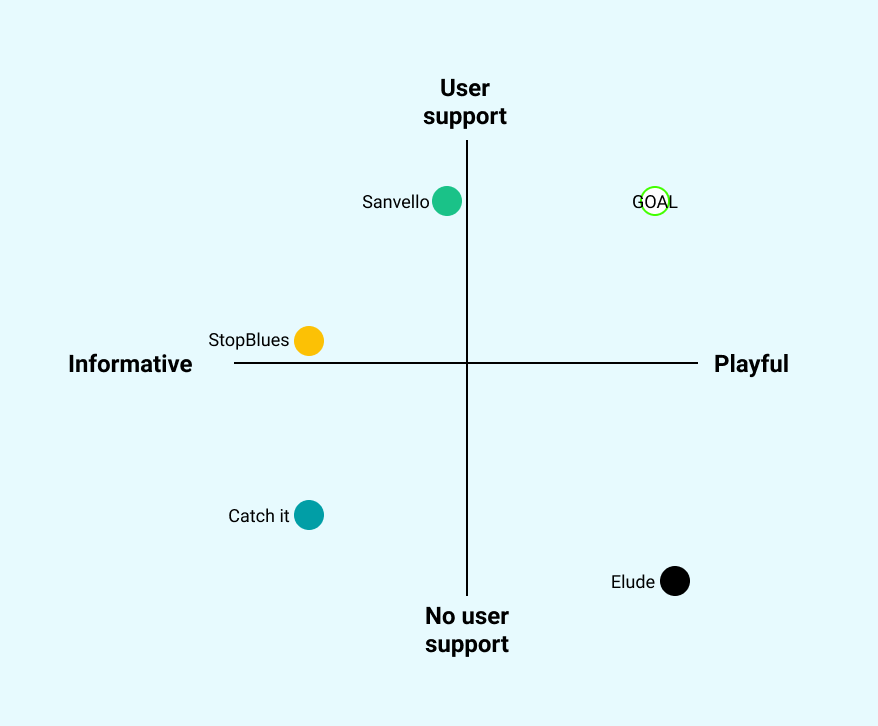
Elude is a playful mobile application that teaches the user to understand the different states of depression.
Catch It is a personal diary to express one's feelings, it is interesting for the user to verbalize what he/she think but there is not real support from the app.
StopBlues explains factors of depression and brings some help and solutions to the user.
Sanvello is the mobile application which propose the most important user support through a customization of the application design, customization of daily questions and analyze of results.
We would like to propose a mobile application more playful to entertain the use while helping him/her to verbalize and improve his feelings.
After secondary research we created a quantitative survey and observed that almost 66% of participants had already experienced a depressive period and most of them didn’t have professional follow-up. Then we interviewed 5 people who are depressed or had a depressive period in the past and 2 main gain points stood out:
Concerning pain points:
We can notice that depressed people don't want to think or speak about their depression to people, existing applications are intrusive for them. They are aware that they need to have daily goals, but do not want these to be imposed through serious therapy.
We have defined 4 How Might We and we have categorized them:
1. DETERMINE -> How might we externalize their problem?
2. LEGITIMIZE -> How might we persuade them that they can be helped?
3. SOLVE -> How might we show them that there is a way out?
4. RELATIVIZE -> How might we encourage them to try several solutions?
Thanks to all this research we validated our problem statement: a day-to-day follow-up that helps anxious and depressive people to fulfill their daily goals and improve their wellness through a mobile app.
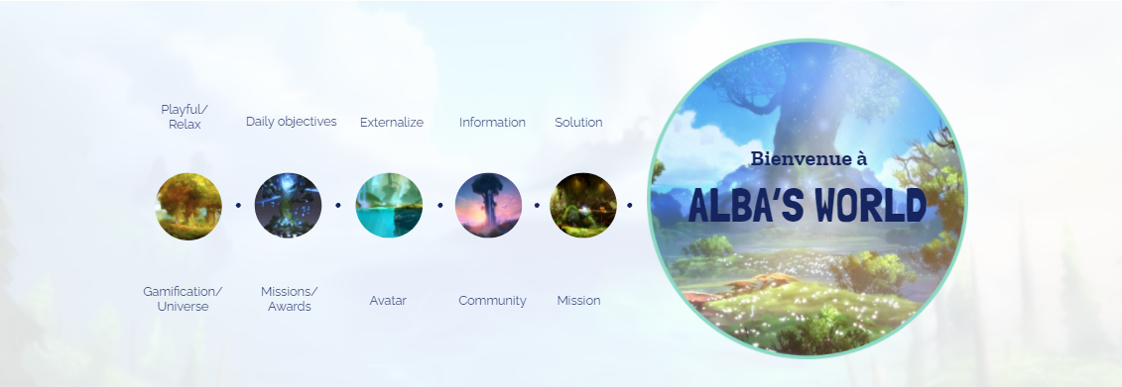
During our interviews we asked to interviewee what they expect from a mobile app which helps them to improve their well-being.
Thanks to all of these feedbacks we created Alba’s World. We chose this name for our game because “Alba” in Spanish and Gallic translates as “daybreak”. The dawn represents renewal and hope.

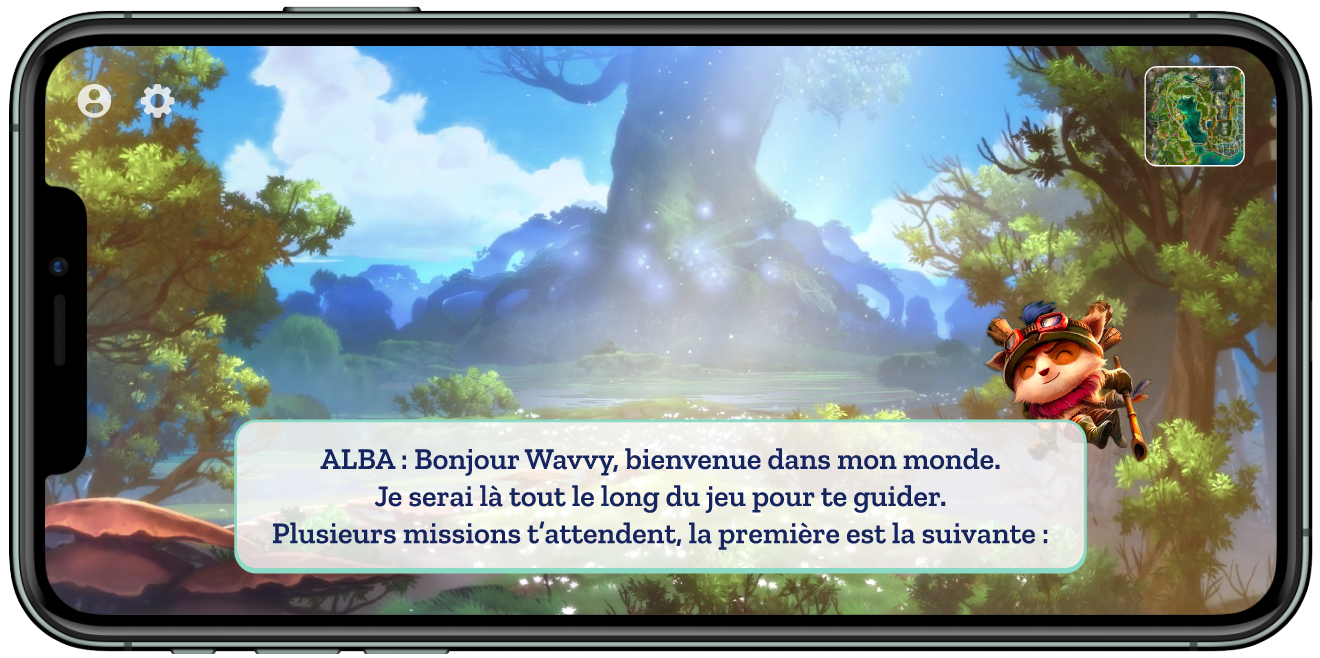
In the game the user will customize his avatar, choose the game design atmosphere he would like, navigate on a map to realise his missions. Each mission will be related to his feelings, good memories, and improvement of well-being.
Between each game play, design colors will change to let the user know that he will still be able to navigate on the map, but that he will have to wait 3 hours before he can play a new game. We want to avoid creating an addiction to the game.

Our moodboard stands out in two atmospheres, days and night to differentiate the gamed played with and without avatar missions. The characters of the game as well as the elements making up the scenery will be soft and pleasant to look at visually.
Bright green tones will dominate the design of our game as the user completes missions across the map. Green is a soothing and invigorating color. The world of the game will be fantastic and vegetal, allowing the user to escape from reality for a moment.
The color blue is associated with serenity and dream. Once all the missions of the gameplay have been successfully completed, the atmosphere of the game will be in shades of blue to soothe the user.
As we couldn't create a game background and our characters, we took inspiration from existing games. We selected the Ori game for the backgrounds because the atmosphere of this fantastic game and the colors matched our expectations. For the choice of the avatar we used the Wildstar game (which is unfortunately no longer in distribution) because many avatar images were available (profile, back, face, etc.). And finally for our characters, we used the champions Teemo, Sona from the game League of Legends, Baymax from the cartoon The New Heroes and the pokemon Toucannon. All these characters were chosen because they inspire confidence and each one is adapted to the proposed mission. For example Baymax that we named in our game Bobby, leads our user to do a meditation mission. So we wanted a gentle character with a reassuring profile for this mission.
.png)
.png)